Jessica Martinez,

Senior Product Designer

Back

Interaction Designer

@Code and TheoryClient → Goldmans Sachs


Finance

Asset Management

Advisor Portal

Operational Systems Design

jess.c.mtz@gmail.com

Linkedin

Designing Operational Infrastructure for Scalable SMA Growth

Snapshot

Role

I served as Interaction Designer on the Advisor Portal, leading the redesign of core account surfaces that defined how Financial Advisors interacted with Goldman Sachs operational workflows.

Objective

The objective was to digitize fragmented SMA processes and reduce operational overhead for Financial Advisors, making it easier to adopt and manage Goldman Sachs investment strategies.

Key Contraints

The project operated within a highly regulated financial environment involving multiple stakeholders including Advisors, Goldman operations teams, custodians, and clients, with many workflows still dependent on manual, non-digital processes.

Key Contraints

The redesigned experience reframed the portal from a performance reporting interface into an operational control surface, introducing a unified account lifecycle event tracker that reduced manual status tracking and established a scalable foundation for future offerings.

Case Study
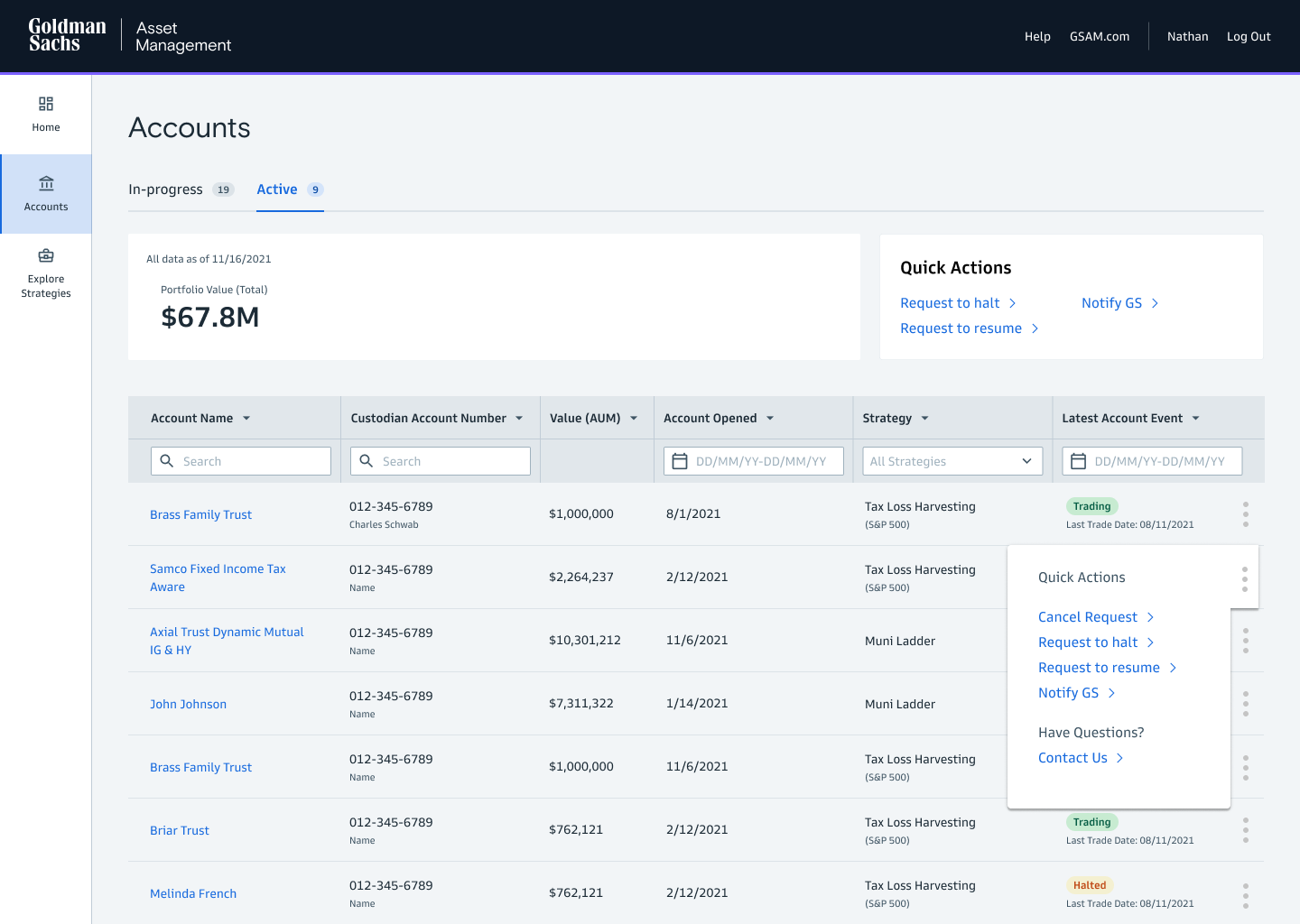
Built a centralized Accounts dashboard that enables advisors to skim across their full book of business with key operational signals surfaced at a glance.
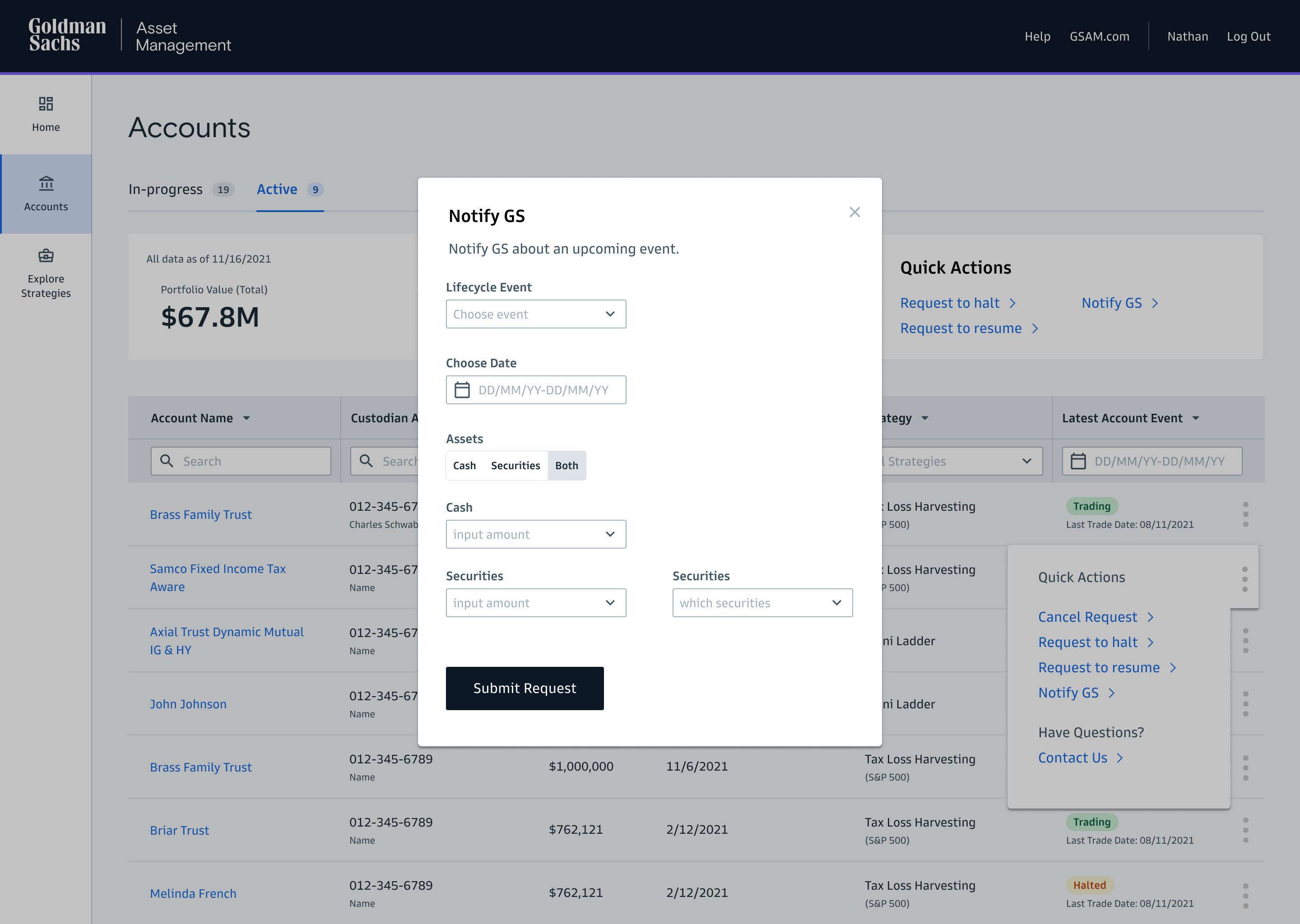
Goldman Sachs set out to attract more Financial Advisors by modernizing how Separately Managed Accounts are onboarded and managed. While SMAs offer customization and flexibility, they introduce operational complexity that discourages adoption. Many workflows remained fragmented across paper, email, custodians, and internal teams. The mandate was not just to design pages, but to connect a distributed process into a scalable digital system that could expand into future offerings.

Initial concepts centered on performance visibility and portfolio storytelling. Through direct advisor interviews and workflow observation, it became clear that performance data was not the bottleneck. Advisors already had access to metrics elsewhere. What they lacked was operational clarity. Account status updates were manually tracked across inboxes, phone calls, and spreadsheets. The real opportunity was reducing uncertainty, not increasing analytics.

I redirected the experience toward a unified account event tracker embedded within a redesigned Accounts Overview. This reframed the portal from a reporting tool into an operational control surface. Key system level information surfaced included account name, custodian number, AUM, strategy, account open date, and most importantly, latest account event. Advisors could now see where an account stood in the lifecycle without chasing multiple parties.

The largest challenge was stakeholder misalignment around which events mattered. The advisor, Goldman operations, custodians, and end clients each influenced the lifecycle. To resolve this, I developed and facilitated journey mapping workshops focused on the full lifecycle from prospect to active funded account. By visualizing the handoffs between institutions, we clarified event definitions and reduced ambiguity across teams. This alignment directly shaped the tracker architecture.

Usability validation focused on three areas:

  • Whether advisors could quickly determine account status without additional context
  • Whether surfaced data reduced follow up communication
  • Whether the event model matched real world expectations

The result was a streamlined operational layer that reduced manual tracking and repositioned the Advisor Portal as infrastructure rather than marketing collateral. More importantly, it established a scalable system foundation that could support additional strategies beyond SMAs.
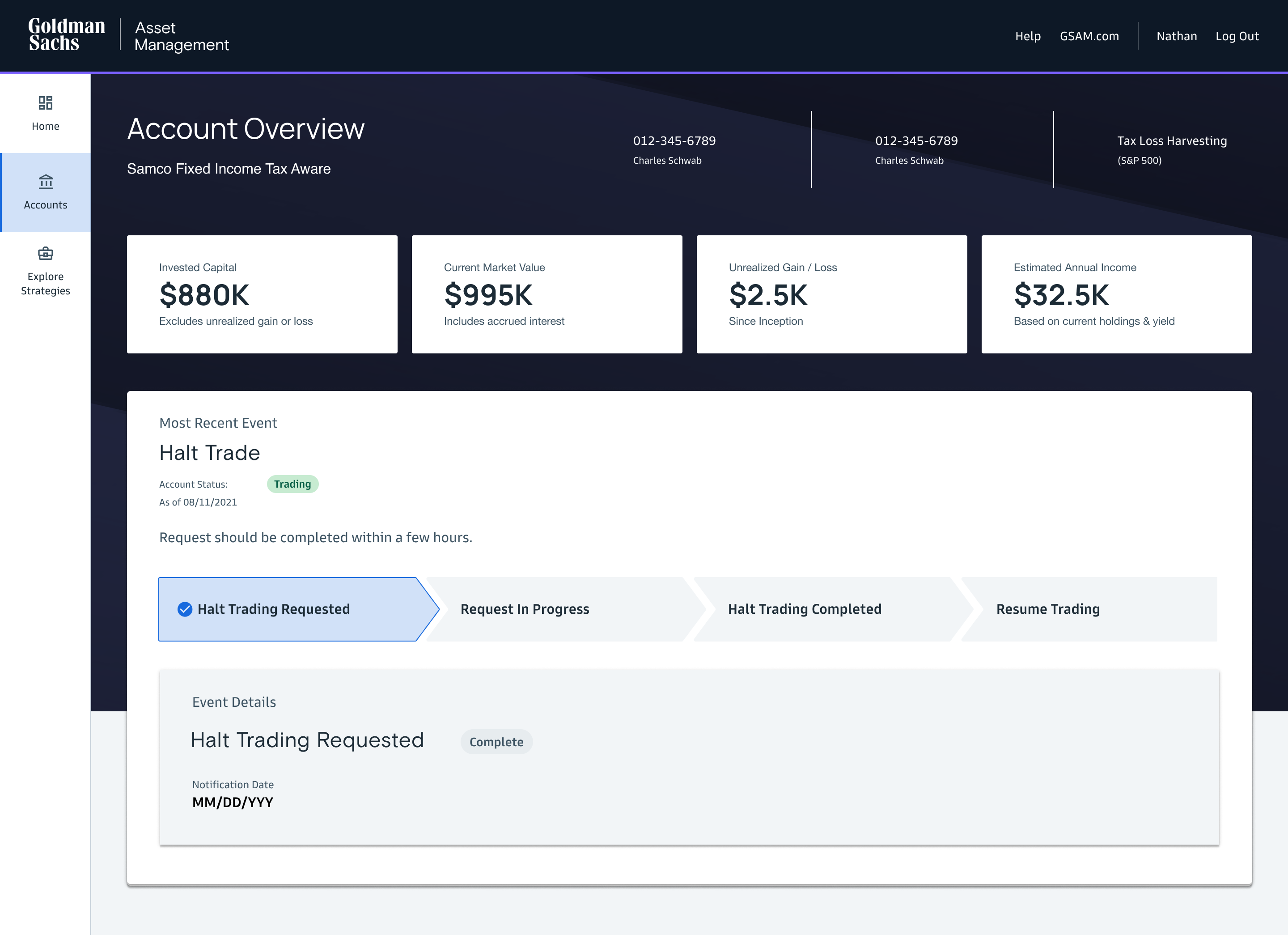
Made lifecycle events explicit and sequential, enabling advisors to understand what has been completed, what is in progress, and what depends on external parties.
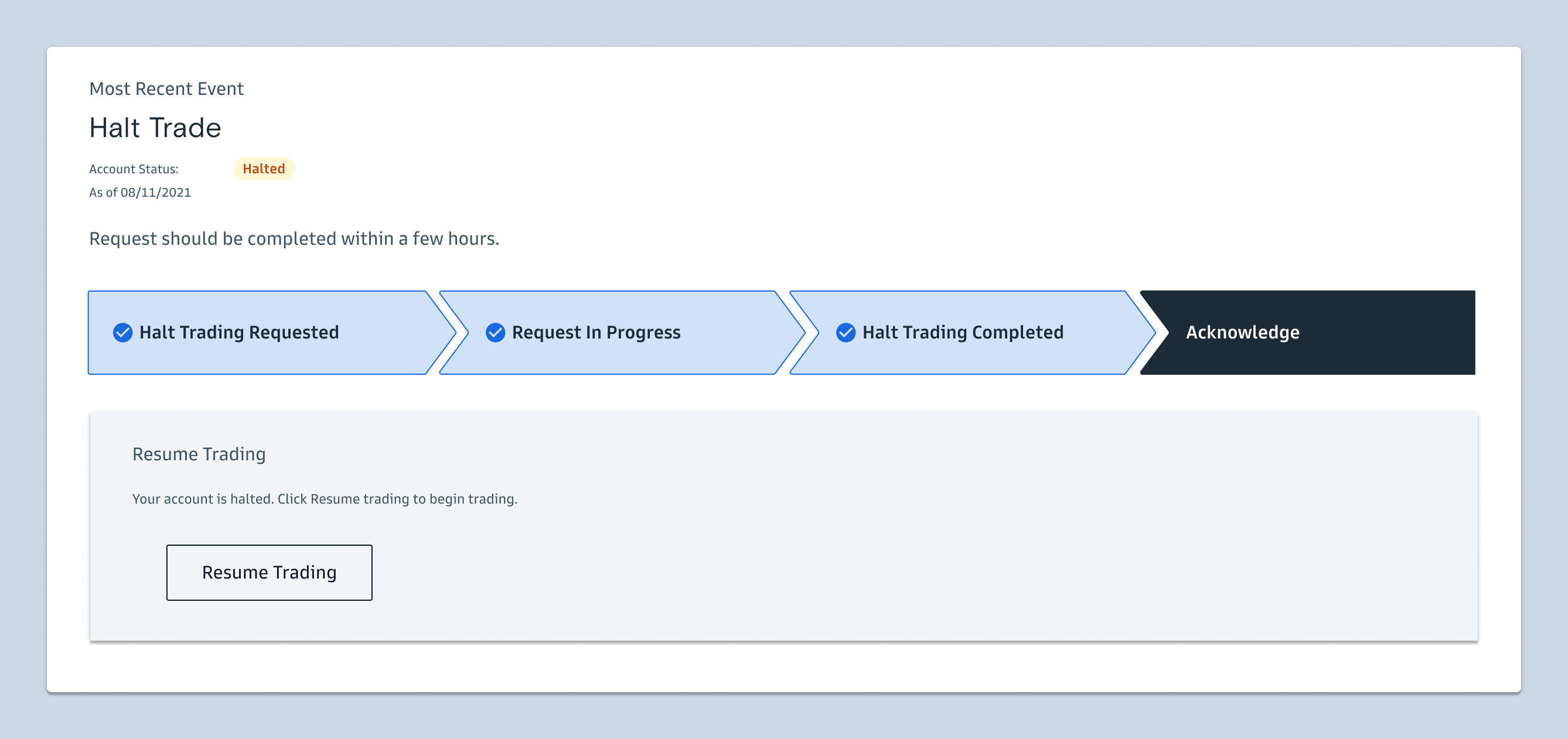
Halt Trade Request → Displays the full lifecycle of a halt request, clarifying when external partners have completed required actions and when the advisor can resume trading.
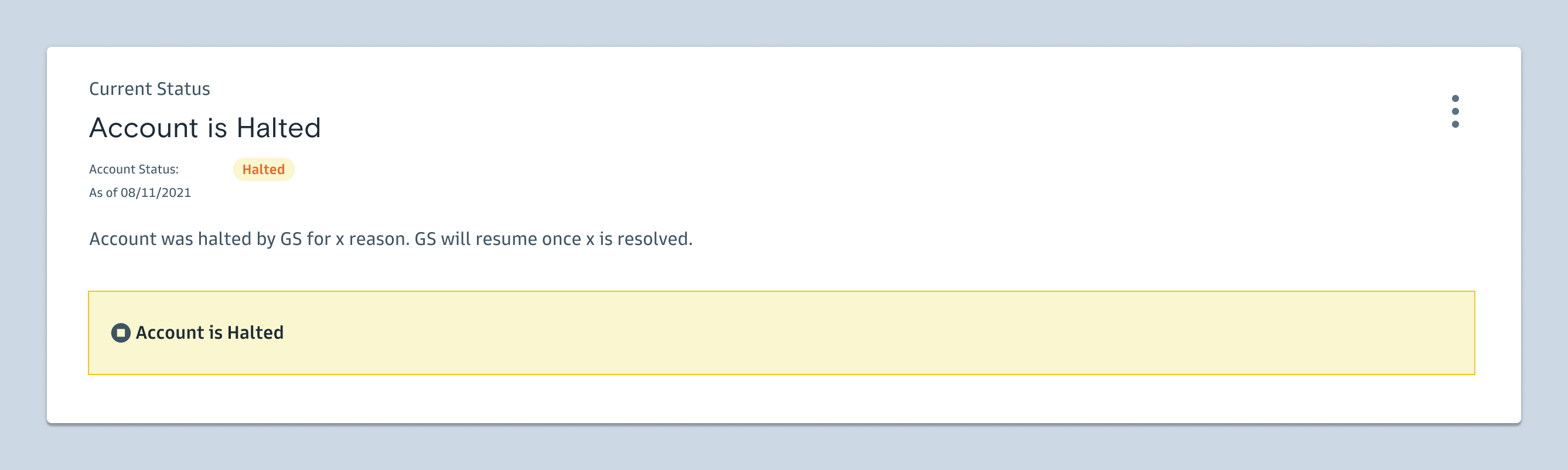
Account Halted → Distinguishes firm initiated restrictions from advisor requests, providing transparency into who paused trading and why.
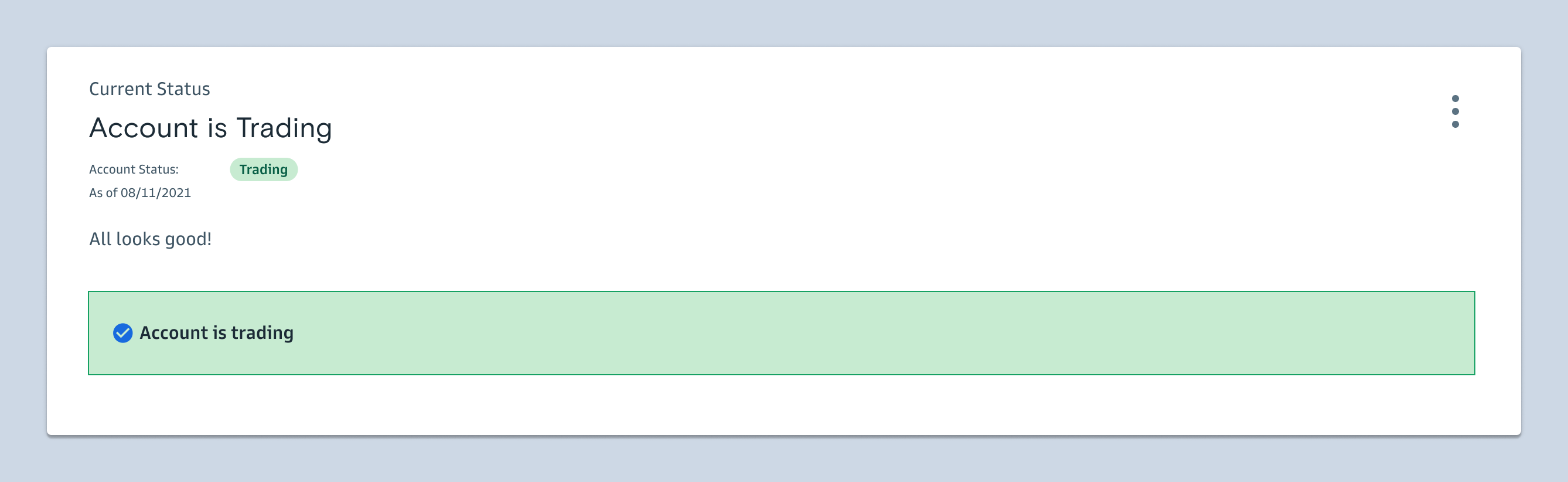
Account is Trading → Establishes a clear baseline state, making deviations such as halts or restrictions immediately noticeable.
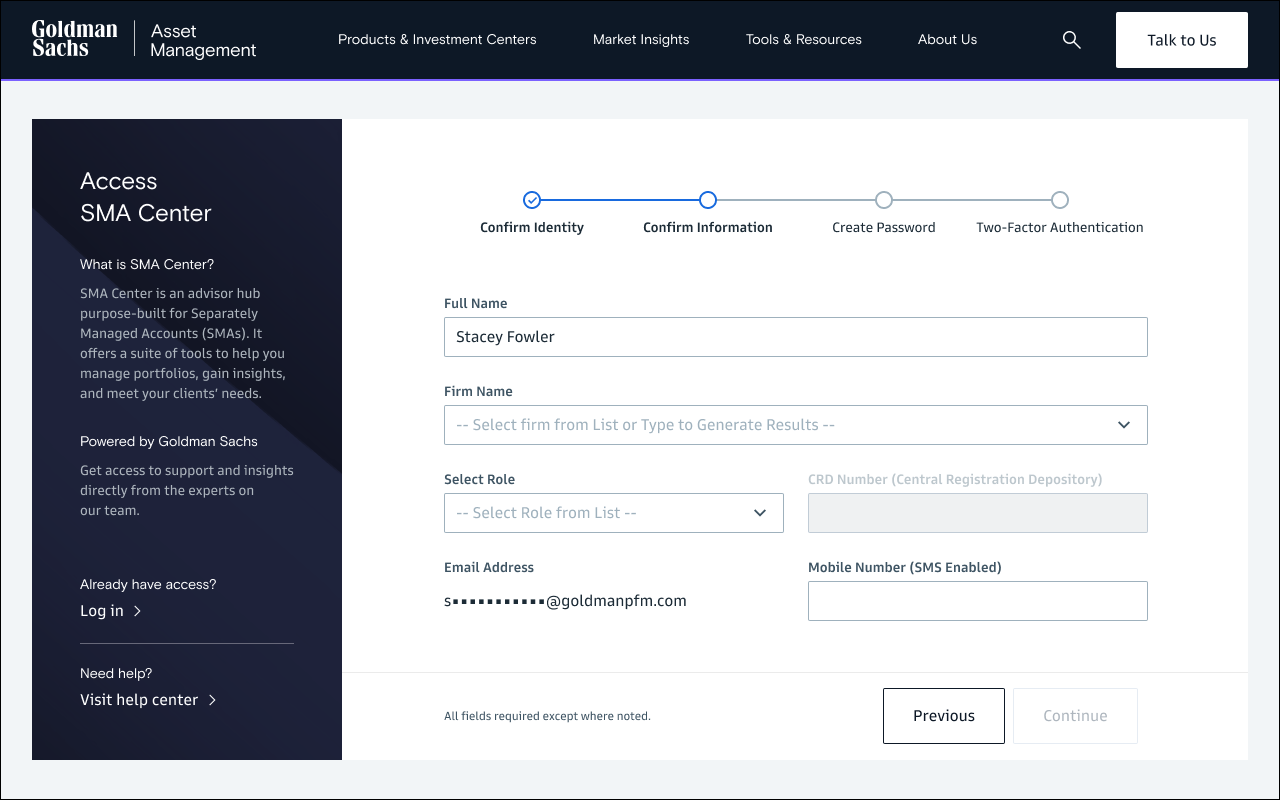
Designed a secure onboarding flow to register new advisors and verify existing ones, establishing identity, firm affiliation, and regulatory credentials before granting access to the SMA Center.

More Projects

Scaling a Beta Experiment into a Core Growth Engine

AI-Powered Renovation Planning

@Block Renovation

Re-Architecting Community Creation for Scalable Web3 Governance

Web3 Governance Infrastructure

@Commonwealth

Jessica Martinez,

Senior Product Designer

Back

Interaction Designer

@Code and TheoryClient → Goldmans Sachs


Finance

Asset Management

Advisor Portal

Operational Systems Design

Linkedin

Designing Operational Infrastructure for Scalable SMA Growth

Snapshot

Role

I served as Interaction Designer on the Advisor Portal, leading the redesign of core account surfaces that defined how Financial Advisors interacted with Goldman Sachs operational workflows.

Objective

The objective was to digitize fragmented SMA processes and reduce operational overhead for Financial Advisors, making it easier to adopt and manage Goldman Sachs investment strategies.

Key Contraints

The project operated within a highly regulated financial environment involving multiple stakeholders including Advisors, Goldman operations teams, custodians, and clients, with many workflows still dependent on manual, non-digital processes.

Key Contraints

The redesigned experience reframed the portal from a performance reporting interface into an operational control surface, introducing a unified account lifecycle event tracker that reduced manual status tracking and established a scalable foundation for future offerings.

Case Study

Built a centralized Accounts dashboard that enables advisors to skim across their full book of business with key operational signals surfaced at a glance.

Goldman Sachs set out to attract more Financial Advisors by modernizing how Separately Managed Accounts are onboarded and managed. While SMAs offer customization and flexibility, they introduce operational complexity that discourages adoption. Many workflows remained fragmented across paper, email, custodians, and internal teams. The mandate was not just to design pages, but to connect a distributed process into a scalable digital system that could expand into future offerings.

Initial concepts centered on performance visibility and portfolio storytelling. Through direct advisor interviews and workflow observation, it became clear that performance data was not the bottleneck. Advisors already had access to metrics elsewhere. What they lacked was operational clarity. Account status updates were manually tracked across inboxes, phone calls, and spreadsheets. The real opportunity was reducing uncertainty, not increasing analytics.

I redirected the experience toward a unified account event tracker embedded within a redesigned Accounts Overview. This reframed the portal from a reporting tool into an operational control surface. Key system level information surfaced included account name, custodian number, AUM, strategy, account open date, and most importantly, latest account event. Advisors could now see where an account stood in the lifecycle without chasing multiple parties.

The largest challenge was stakeholder misalignment around which events mattered. The advisor, Goldman operations, custodians, and end clients each influenced the lifecycle. To resolve this, I developed and facilitated journey mapping workshops focused on the full lifecycle from prospect to active funded account. By visualizing the handoffs between institutions, we clarified event definitions and reduced ambiguity across teams. This alignment directly shaped the tracker architecture.

Usability validation focused on three areas:

  • Whether advisors could quickly determine account status without additional context
  • Whether surfaced data reduced follow up communication
  • Whether the event model matched real world expectations

The result was a streamlined operational layer that reduced manual tracking and repositioned the Advisor Portal as infrastructure rather than marketing collateral. More importantly, it established a scalable system foundation that could support additional strategies beyond SMAs.

Made lifecycle events explicit and sequential, enabling advisors to understand what has been completed, what is in progress, and what depends on external parties.

Halt Trade Request → Displays the full lifecycle of a halt request, clarifying when external partners have completed required actions and when the advisor can resume trading.

Account Halted → Distinguishes firm initiated restrictions from advisor requests, providing transparency into who paused trading and why.

Account is Trading → Establishes a clear baseline state, making deviations such as halts or restrictions immediately noticeable.

Designed a secure onboarding flow to register new advisors and verify existing ones, establishing identity, firm affiliation, and regulatory credentials before granting access to the SMA Center.

More Projects

Scaling a Beta Experiment into a Core Growth Engine

AI-Powered Renovation Planning

@Block Renovation

Re-Architecting Community Creation for Scalable Web3 Governance

Web3 Governance Infrastructure

@Commonwealth

Jessica Martinez,

Senior Product Designer

Back

Interaction Designer

@Code and TheoryClient → Goldmans Sachs


Finance

Asset Management

Advisor Portal

Operational Systems Design

jess.c.mtz@gmail.com

Linkedin

Designing Operational Infrastructure for Scalable SMA Growth

Snapshot

Role

I served as Interaction Designer on the Advisor Portal, leading the redesign of core account surfaces that defined how Financial Advisors interacted with Goldman Sachs operational workflows.

Objective

The objective was to digitize fragmented SMA processes and reduce operational overhead for Financial Advisors, making it easier to adopt and manage Goldman Sachs investment strategies.

Key Constraints

The project operated within a highly regulated financial environment involving multiple stakeholders including Advisors, Goldman operations teams, custodians, and clients, with many workflows still dependent on manual, non-digital processes.

Outcomes

The redesigned experience reframed the portal from a performance reporting interface into an operational control surface, introducing a unified account lifecycle event tracker that reduced manual status tracking and established a scalable foundation for future offerings.

Case Study

Built a centralized Accounts dashboard that enables advisors to skim across their full book of business with key operational signals surfaced at a glance.

Goldman Sachs set out to attract more Financial Advisors by modernizing how Separately Managed Accounts are onboarded and managed. While SMAs offer customization and flexibility, they introduce operational complexity that discourages adoption. Many workflows remained fragmented across paper, email, custodians, and internal teams. The mandate was not just to design pages, but to connect a distributed process into a scalable digital system that could expand into future offerings.

Initial concepts centered on performance visibility and portfolio storytelling. Through direct advisor interviews and workflow observation, it became clear that performance data was not the bottleneck. Advisors already had access to metrics elsewhere. What they lacked was operational clarity. Account status updates were manually tracked across inboxes, phone calls, and spreadsheets. The real opportunity was reducing uncertainty, not increasing analytics.

I redirected the experience toward a unified account event tracker embedded within a redesigned Accounts Overview. This reframed the portal from a reporting tool into an operational control surface. Key system level information surfaced included account name, custodian number, AUM, strategy, account open date, and most importantly, latest account event. Advisors could now see where an account stood in the lifecycle without chasing multiple parties.

The largest challenge was stakeholder misalignment around which events mattered. The advisor, Goldman operations, custodians, and end clients each influenced the lifecycle. To resolve this, I developed and facilitated journey mapping workshops focused on the full lifecycle from prospect to active funded account. By visualizing the handoffs between institutions, we clarified event definitions and reduced ambiguity across teams. This alignment directly shaped the tracker architecture.

Usability validation focused on three areas:

  • Whether advisors could quickly determine account status without additional context
  • Whether surfaced data reduced follow up communication
  • Whether the event model matched real world expectations

The result was a streamlined operational layer that reduced manual tracking and repositioned the Advisor Portal as infrastructure rather than marketing collateral. More importantly, it established a scalable system foundation that could support additional strategies beyond SMAs.

Made lifecycle events explicit and sequential, enabling advisors to understand what has been completed, what is in progress, and what depends on external parties.

Halt Trade Request → Displays the full lifecycle of a halt request, clarifying when external partners have completed required actions and when the advisor can resume trading.

Account Halted → Distinguishes firm initiated restrictions from advisor requests, providing transparency into who paused trading and why.

Account is Trading → Establishes a clear baseline state, making deviations such as halts or restrictions immediately noticeable.

Designed a secure onboarding flow to register new advisors and verify existing ones, establishing identity, firm affiliation, and regulatory credentials before granting access to the SMA Center.

More Projects

Scaling a Beta Experiment into a Core Growth Engine

AI-Powered Renovation Planning

@Block Renovation

Re-Architecting Community Creation for Scalable Web3 Governance

Web3 Governance Infrastructure

@Commonwealth