Product Designer
@Block Renovation
AI-Powered Renovation Planning0→1 Beta to Core PlatformGrowth + Conversion Infrastructure
jess.c.mtz@gmail.com
↗
↗
Scaling a Beta Experiment into a Core Growth Engine
Snapshot
Role
Lead Product Designer, owned end to end strategy and experience for Studio and led its evolution from beta experiment to integrated platform product.
Objective
Shorten the renovation purchase cycle by converting high intent but hesitant homeowners into qualified, renovation ready clients through early cost clarity and visualization.
Key Contraints
High ticket, emotionally complex decisions; integration within a live platform; duplicate account risk across beta and core systems; alignment between AI outputs and real contractor pricing; limited data in an experimental stage.
Key Contraints
Validated Studio as a revenue generating acquisition channel, converted planning users into active projects, unified onboarding and dashboard systems, and embedded the product into Block’s core growth strategy.
Case Study
Context → Block Renovation helps homeowners renovate through vetted contractor matching. The challenge was not demand but delay. Renovations are high ticket and emotionally overwhelming decisions, and high intent homeowners were stalling before ever speaking to a contractor.
Studio launched as a beta to test a simple hypothesis: if we could reduce ambiguity earlier in the journey, we could help homeowners commit faster and enter the contractor-matching process with more confidence.
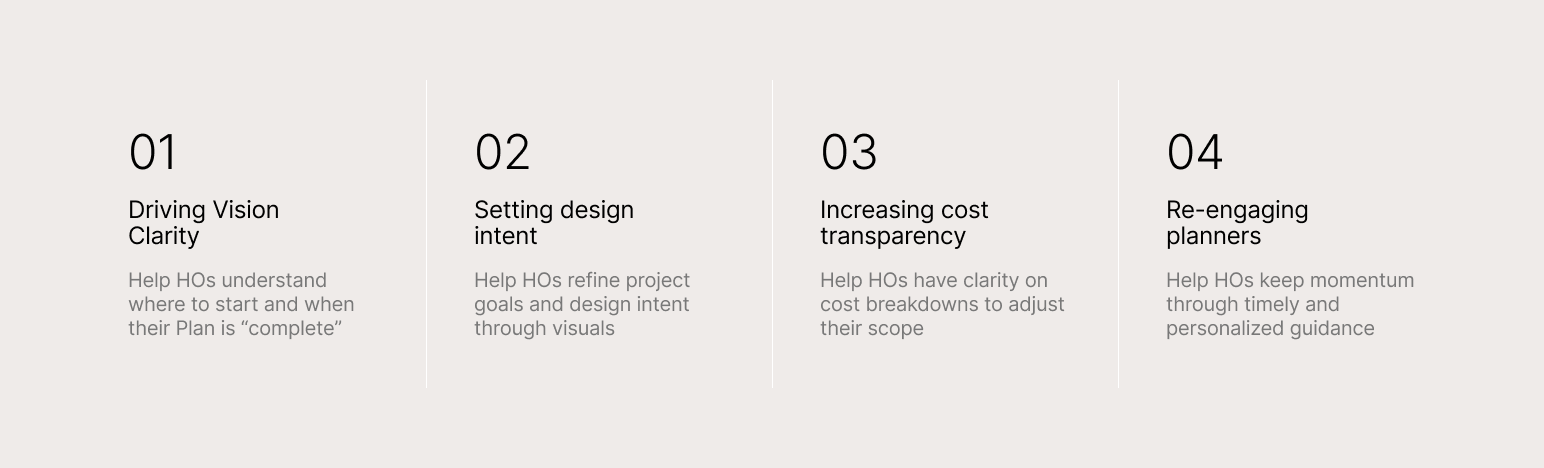
The strategy centered on four moments of homeowner confidence: vision clarity, design intent, cost transparency, and re-engagement.
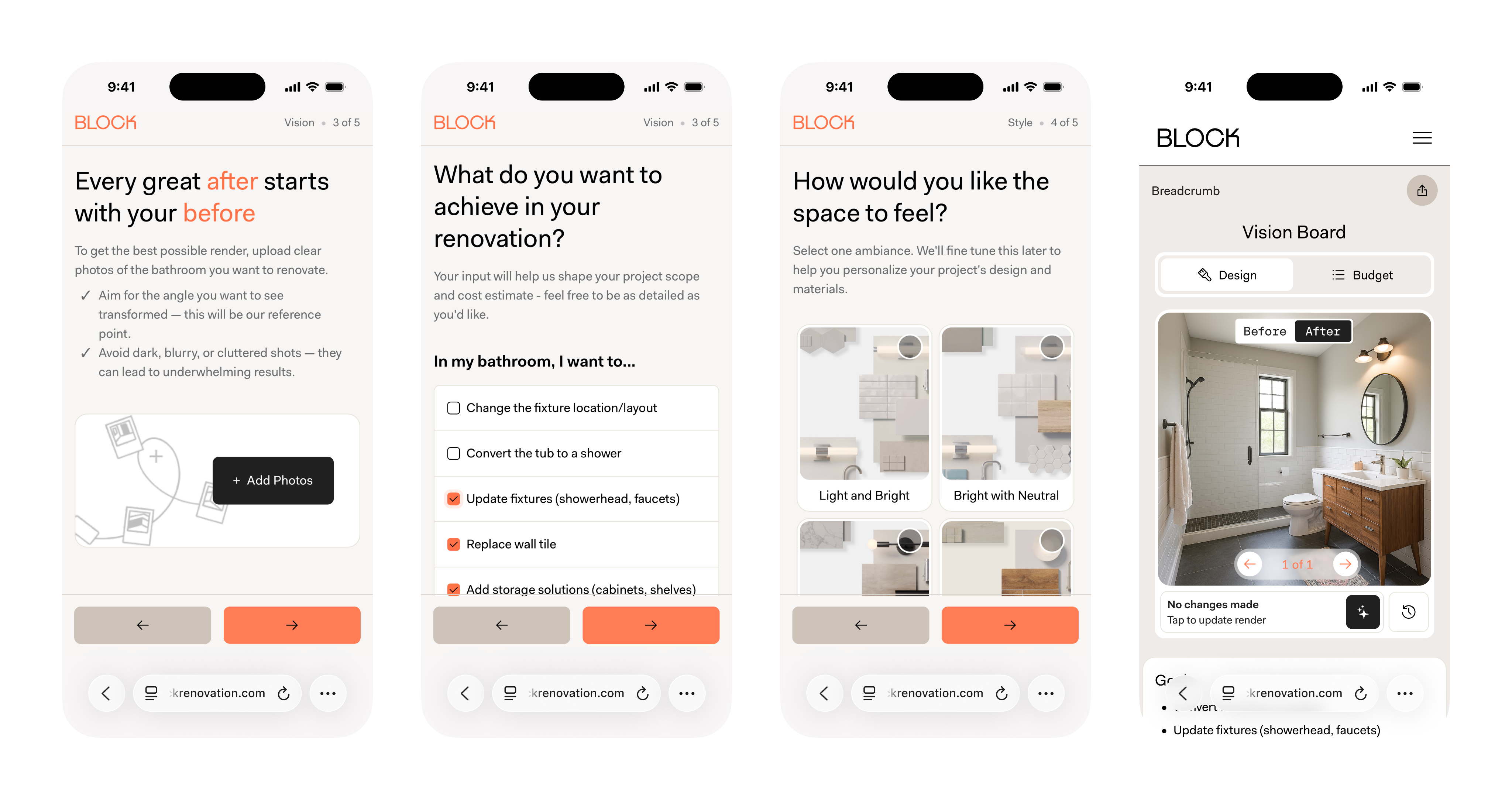
Ownership Shift → I joined to support the beta product, but midway through development leadership transitioned and I assumed full ownership. What began as an experiment now required decisive direction. Studio needed to either validate as a meaningful business lever or sunset. I took responsibility for defining its path forward.
Strategic Evolution → Studio used AI to generate renovation cost estimates and visual renders from a homeowner’s uploaded photo. The real shift was not technical but strategic. We reframed Studio from a planning tool into a confidence engine designed to capture earlier intent, increase decision readiness, and feed qualified homeowners into the contractor matching pipeline. Once it began generating real renovation projects, the question changed from “Does this work?” to “How does this become foundational?”
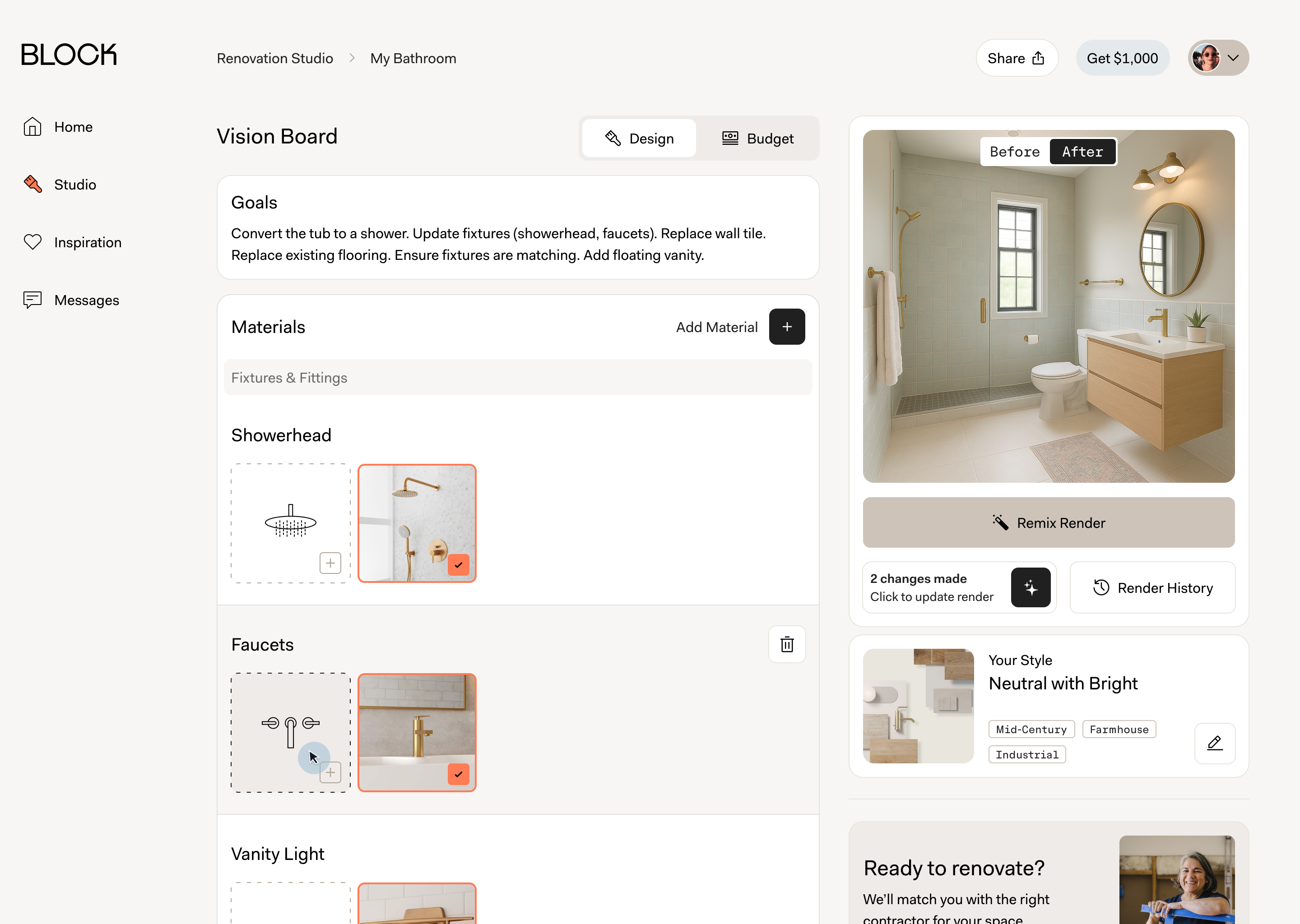
Post-onboarding Studio vision board → After onboarding, Studio generated a starting vision for the homeowner, including an ideal-space render, interpreted goals, and a pre-filled material direction.
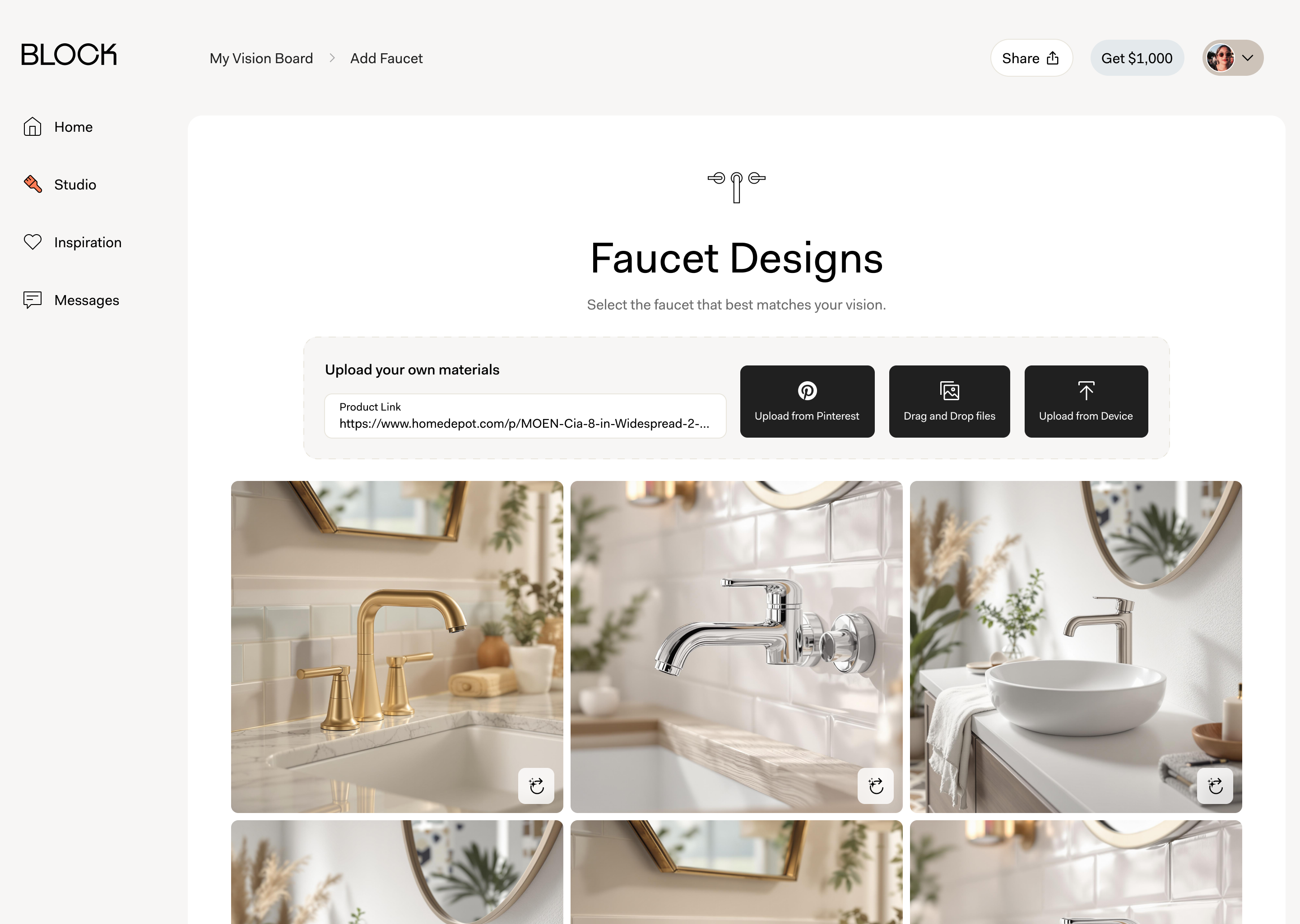
Paste product link interaction → Users could add a specific product, like a faucet, by pasting a link into Studio instead of manually recreating their preferences.
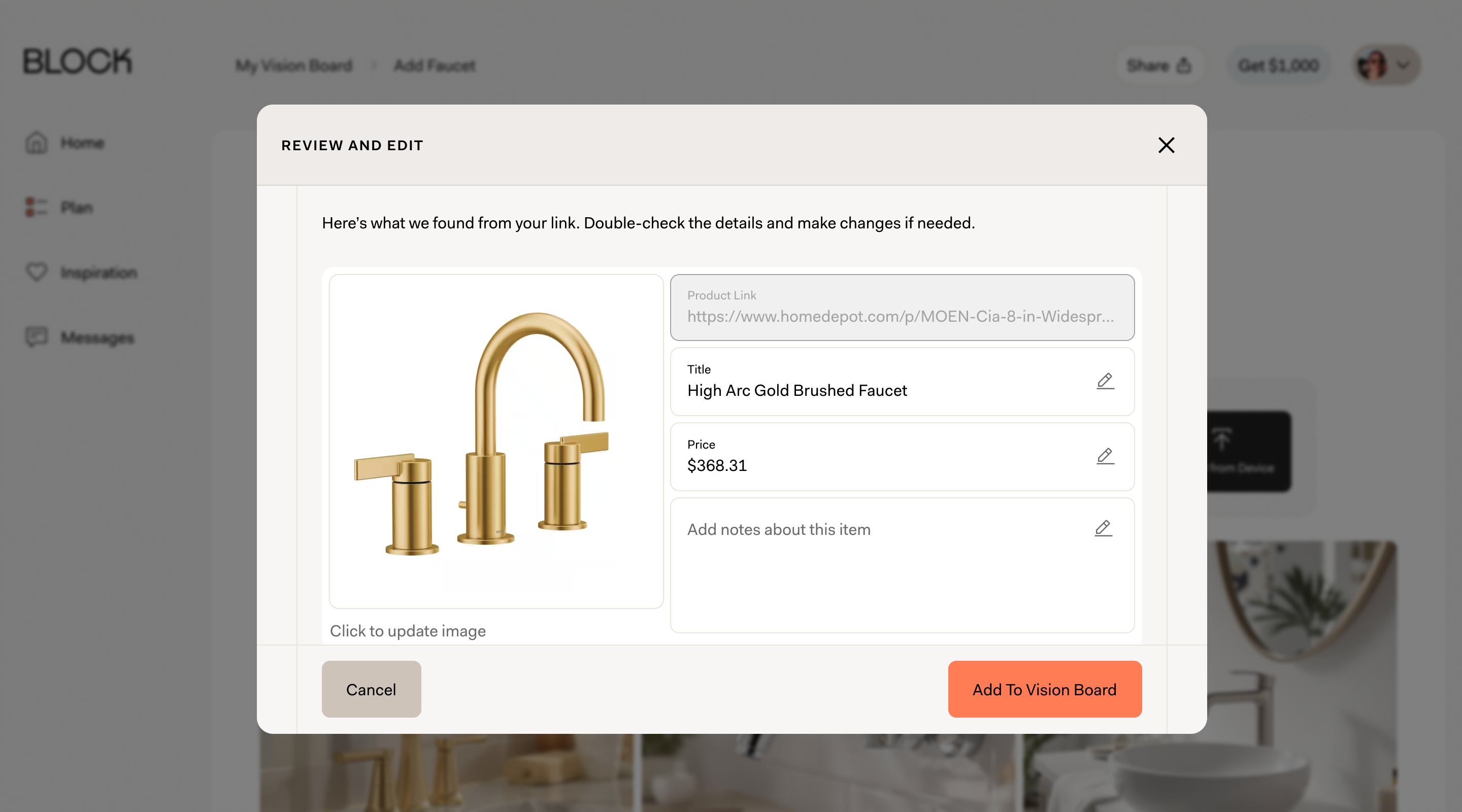
Review and edit modal → Before adding the item, Studio asked users to review and confirm the extracted product information so AI-assisted inputs stayed editable and trustworthy.
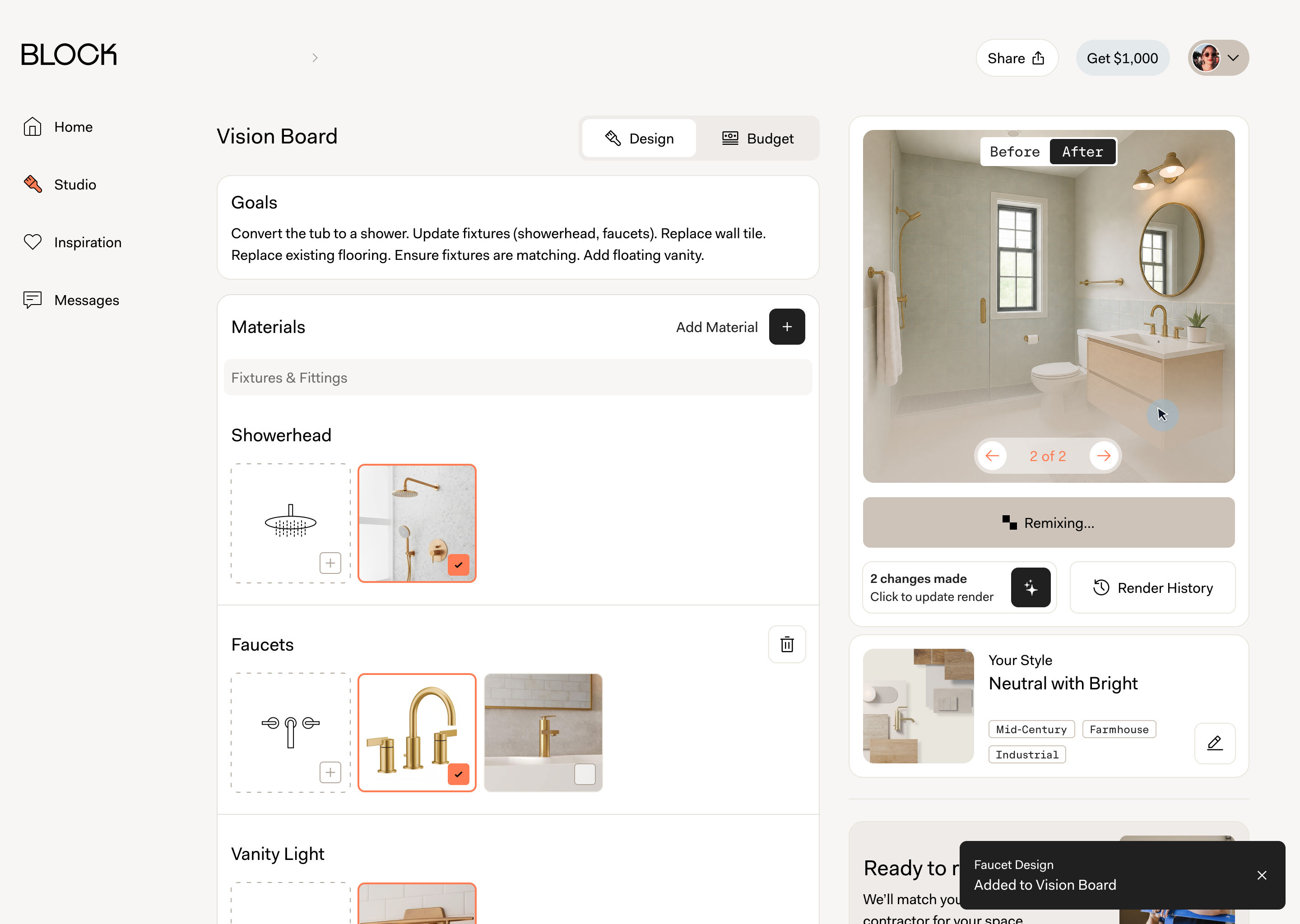
Updated vision board + remixing render state → Once added, the selected faucet appeared alongside the original material choice while Studio remixed the render to reflect the updated vision.
Integration → We made the decision to merge Studio into Block’s core platform. This required rearchitecting onboarding across products, unifying dashboards for exploratory planners and active clients, resolving duplicate user and account logic, and aligning marketing acquisition with product flows. Studio transitioned from a standalone beta feature into embedded growth infrastructure.
Impact → Studio generated revenue from renovation projects originating in the planning experience and established a scalable top of funnel acquisition path. It reduced friction between inspiration and contractor engagement and became a permanent part of Block’s platform strategy.
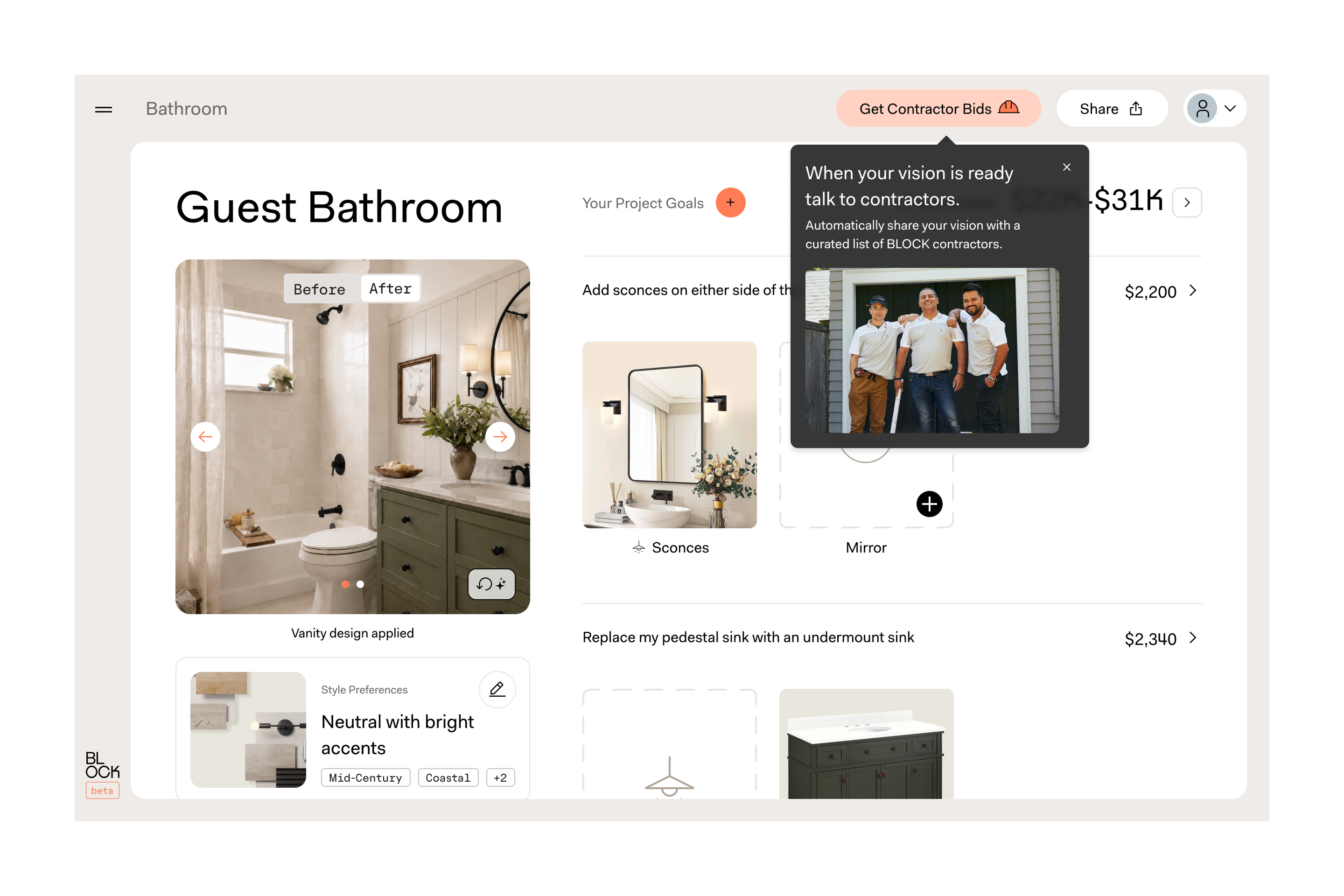
Pre-unification Studio experience → Before unification, Studio operated as its own product experience, separate from the core homeowner dashboard and marketplace flow.
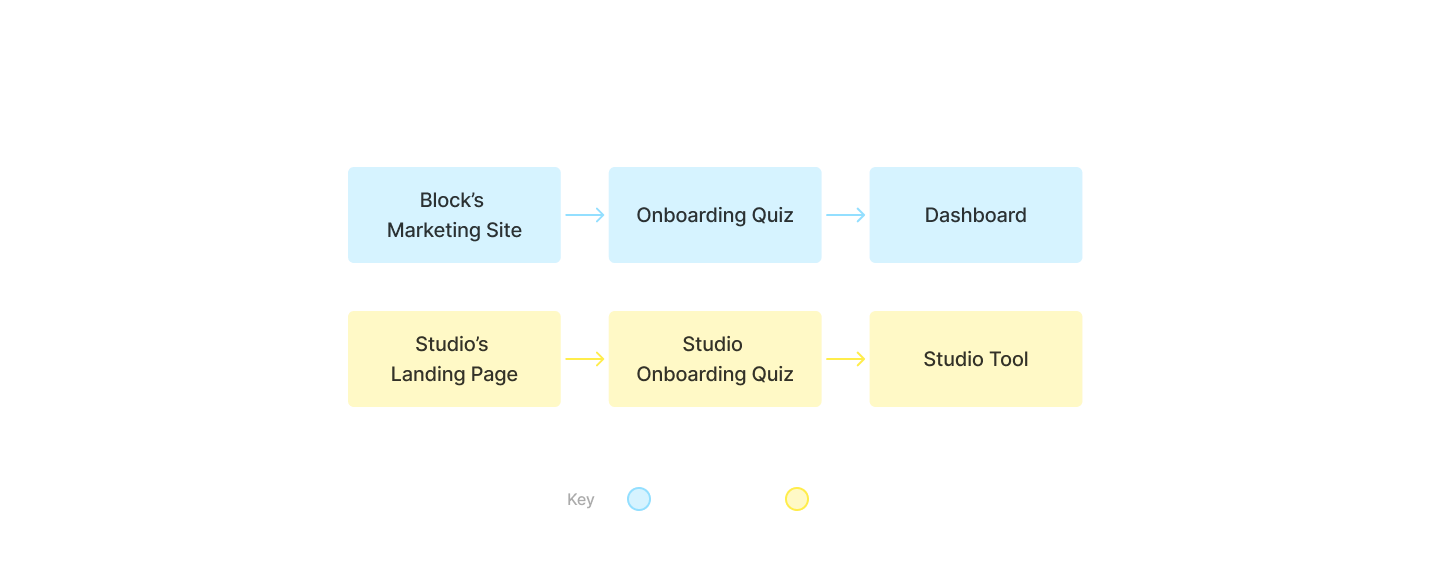
Separate beta flow diagram → The standalone model helped us launch quickly, but it created friction between Studio planning activity and the contractor-matching funnel.
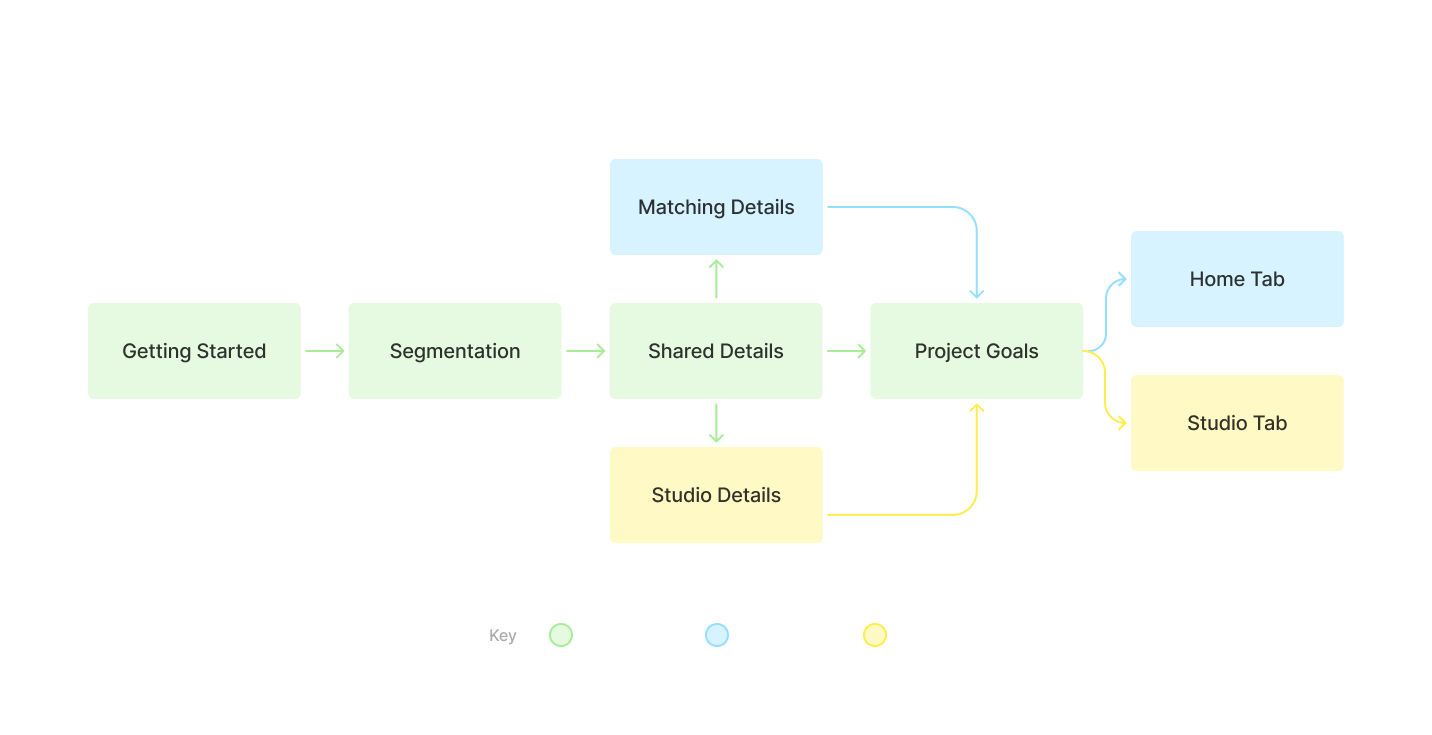
Unified platform flow diagram → The unified model connected shared project inputs, Studio planning details, and the homeowner dashboard into one continuous journey.
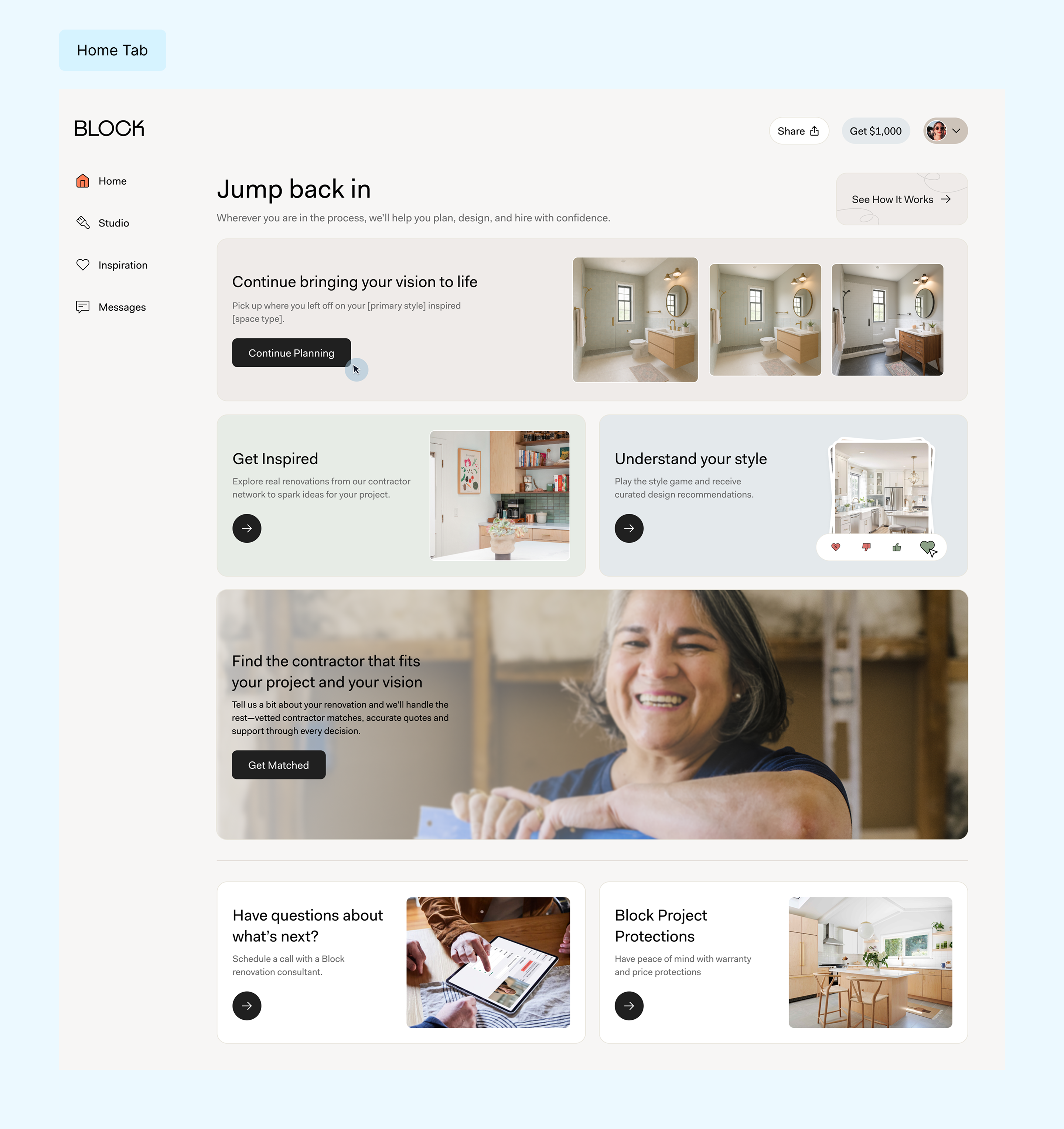
Dashboard homepage after Studio touchpoint → After unification, Studio activity connected back into the dashboard, helping homeowners continue planning and move toward contractor matching when ready.
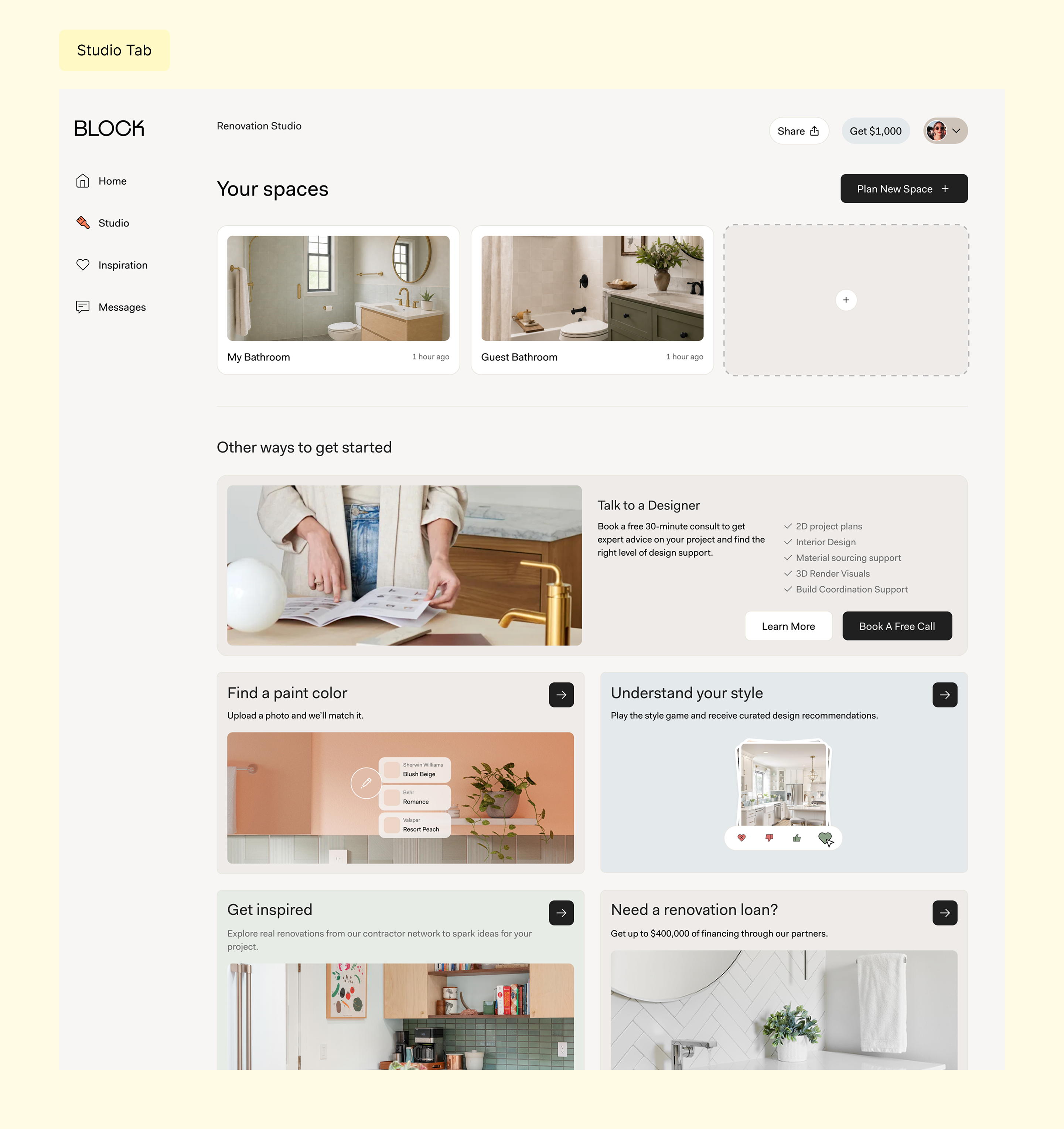
Dashboard homepage after Studio touchpoint → After unification, Studio activity connected back into the dashboard, helping homeowners continue planning and move toward contractor matching when ready.
Studio generated renovation momentum. The AI planning experience showed why. The platform work made that momentum scalable.
More Projects
Re-Architecting Community Creation for Scalable Web3 Governance
Web3 Governance Infrastructure
@Commonwealth
↗
Designing Operational Infrastructure for Scalable SMA Growth
Finance | Advisor Portal
@Code and Thoery
↗
Designing a visual preference game to capture homeowner taste
Consumer UX | Playful Onboarding
@Block Renovation
↗
Redesigning contractor work orders for faster job qualification
Marketplace Operations | B2B
@Block Renovation
↗